How to keep someone with dementia safe at home
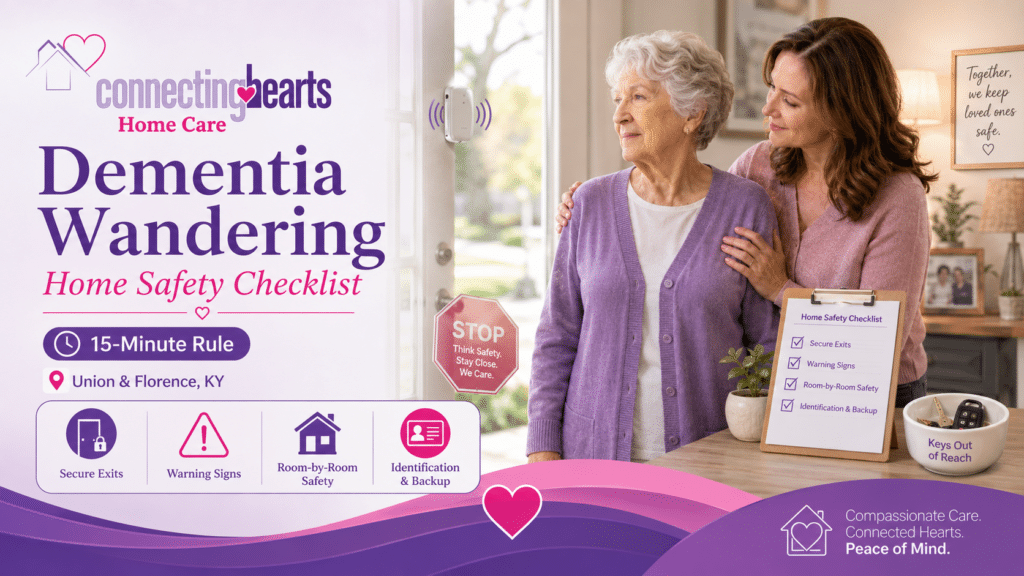
Six in ten people living with dementia will wander at least once, according to the Alzheimer’s Association, and many do so repeatedly. It can happen at any stage of the disease, including early on, and it can happen to families who are paying close attention. Reducing the risk at home comes down to three things: securing exits, removing the triggers that prompt someone to leave, and having a plan ready before you need it. If a person with dementia goes missing and isn’t found within 15 minutes, the Alzheimer’s Association advises calling 911, filing a missing person report, and telling responders the person has dementia.
That 15-minute rule is the most important sentence in this article. Don’t wait out of embarrassment. Don’t spend an hour driving around first.
Warning signs someone is at risk
The Alzheimer’s Association lists these among the common signs:
- Returning from a regular walk or drive later than usual
- Forgetting how to get to familiar places
- Talking about fulfilling former obligations, like going to work
- Trying or wanting to go home while already at home
- Becoming restless, pacing, or making repetitive movements
Everyone living with Alzheimer’s or another dementia is at risk. If your parent can walk, or still has access to car keys, this applies to them.
Wandering also isn’t always on foot. A person can wander in a car, and Northern Kentucky families near I-275, US 27, and the AA Highway have real reason to take the driving question seriously earlier than feels comfortable.
Why people wander
Almost always, there’s a purpose behind it even when the purpose doesn’t make sense to you.
Someone may be trying to get to a home they lived in forty years ago. Someone may be going to a job they retired from in 1998. Someone may be looking for a bathroom, or a spouse, or their mother. Someone may simply be restless and agitated, especially in the late afternoon, which is why sundowning and wandering often show up together.
Understanding the “why” changes the fix. If your father tries the front door every afternoon around 4 p.m. because he thinks he needs to pick up the kids from school, a deadbolt alone won’t settle him. A structured activity at 3:45 p.m. might.
Room-by-room home safety checklist
Walk the house with fresh eyes. What was safe two years ago may not be safe now.
Doors and exits
- Add locks the person is unlikely to use, placed high or low on exterior doors
- Install door chimes or simple alarms so you hear a door open
- Label the bathroom and bedroom doors with signs or pictures, since many attempts at the exterior door are really someone looking for the bathroom
- Keep car keys out of sight if driving has become unsafe
- Consider a stop sign or “do not enter” sign on exterior doors, which many people with dementia will honor
Kitchen
- Remove or disable stove knobs, or install an automatic shutoff device
- Store knives, cleaning products, and small appliances out of reach
- Check the refrigerator weekly for spoiled food, since smell and taste both change
Bathroom
- Grab bars at the toilet and in the shower
- Non-slip mat and a shower chair
- Set the water heater no higher than 120 degrees
- Remove interior door locks, or reverse them so the door opens from outside
Throughout the house
- Take up throw rugs and secure loose cords
- Add night lights along the path from bed to bathroom
- Improve lighting overall, since shadows and glare cause misperception, and misperception causes fear
- Lock up medications, alcohol, tools, and firearms
- Clear clutter from walkways
Identification and backup
- Make sure the person carries or wears identification
- Give a recent photo and written description to trusted neighbors
- Tell nearby neighbors what’s happening and give them your cell number
- Write down places the person might try to go: a former address, a former workplace, a church, a cemetery
- Keep that list where anyone in the family can find it fast
The part most families skip
Tell the neighbors.
Families often keep a dementia diagnosis quiet out of a sense of privacy or protectiveness. It’s understandable, and it also removes the most useful safety net you have. In neighborhoods across Union, Florence, and Fort Mitchell, the person most likely to spot your mother walking down the street at an odd hour is the neighbor two doors down.
You don’t have to explain everything. “Mom has memory trouble now. If you see her out alone, would you call me?” is enough.
When supervision becomes the actual answer
Locks and alarms reduce risk. They don’t eliminate it, and they don’t help at all if nobody’s home.
At some point the honest question stops being “how do we secure the house” and becomes “how many hours can this person safely be alone?” For a lot of families, the answer shrinks faster than they expected.
That’s usually when a few hours of supervision each day starts making sense, and when overnight coverage becomes a real conversation. Connecting Hearts Home Care offers in-home dementia care that includes safety supervision, routine support, cueing, and companionship, and 24-hour home care without live-in care when someone needs continuous support day and night.
We’ve provided non-medical in-home care in Northern Kentucky for 23 years, serving Union, Florence, Fort Thomas, Alexandria, Cold Spring, Erlanger, Fort Mitchell, Fort Wright, Villa Hills, Wilder, and nearby communities in Boone, Campbell, and Kenton counties.
Take the next step
Our free guide, Understanding Dementia Care at Home, includes this safety walkthrough plus sections on sundowning, communication, personal care refusals, how families pay for dementia care, and twelve questions to ask any agency before you hire.
Download the free guide: Understanding Dementia Care at Home
Schedule a Free In-Home Consultation at https://connectingheartshomecare.com/get-started/ or call (859) 441-7977.
Connecting Hearts Home Care 654 Highland Ave, Suite 17, Fort Thomas, KY 41075 Phone: (859) 441-7977 | https://connectingheartshomecare.com Commonwealth of Kentucky Cabinet for Health and Family Services, Certification Number PSA500002